Tuesday, January 12, 2016

Namibia: Sossusvlei and Deadvlei

Other Posts: Trip Overview, Little Kulala Lodge

Eddie (our guide) politely called out "good morning" from the other side of our door. It was 5:30am, the time of our wake-up call. We expected it to be a hot day but stuck with our long sleeve safari shirts to help protect us from the sun. We were going to look at the sand dunes in the area known as Sossusvlei. This is the area where stock photos are created of dead trees against a red sand background. We learned that the trees are technically in Deadvlei (dead lake) and Sossusvlei (dead end lake) is a separate distinct site even though it's the commonly used name for the whole area.

The camp's buffet was nice with a variety of fruits, meat, cheeses, pastries, porridge, and beverages. We could also order hot breakfast of bacon, eggs, sausage. Our jeep-mate this morning was Judith. She was from Portugal and was touring Africa for three weeks after visiting her niece living in Mozambique.

The first 45 minutes of our drive was pretty uneventful. Oryx, springbok, tree, repeat. We eventually left the rock/sand road and found our way onto the highway: a narrow two-way strip of asphalt. We started seeing large tour buses, campers, and other signs that we were on the main tourist track. We did take breaks for photos along the way.

Our first stop was to look at Dune 45, named for its kilometer marker location on the road. People were already at the top this early. We call them the smart ones.

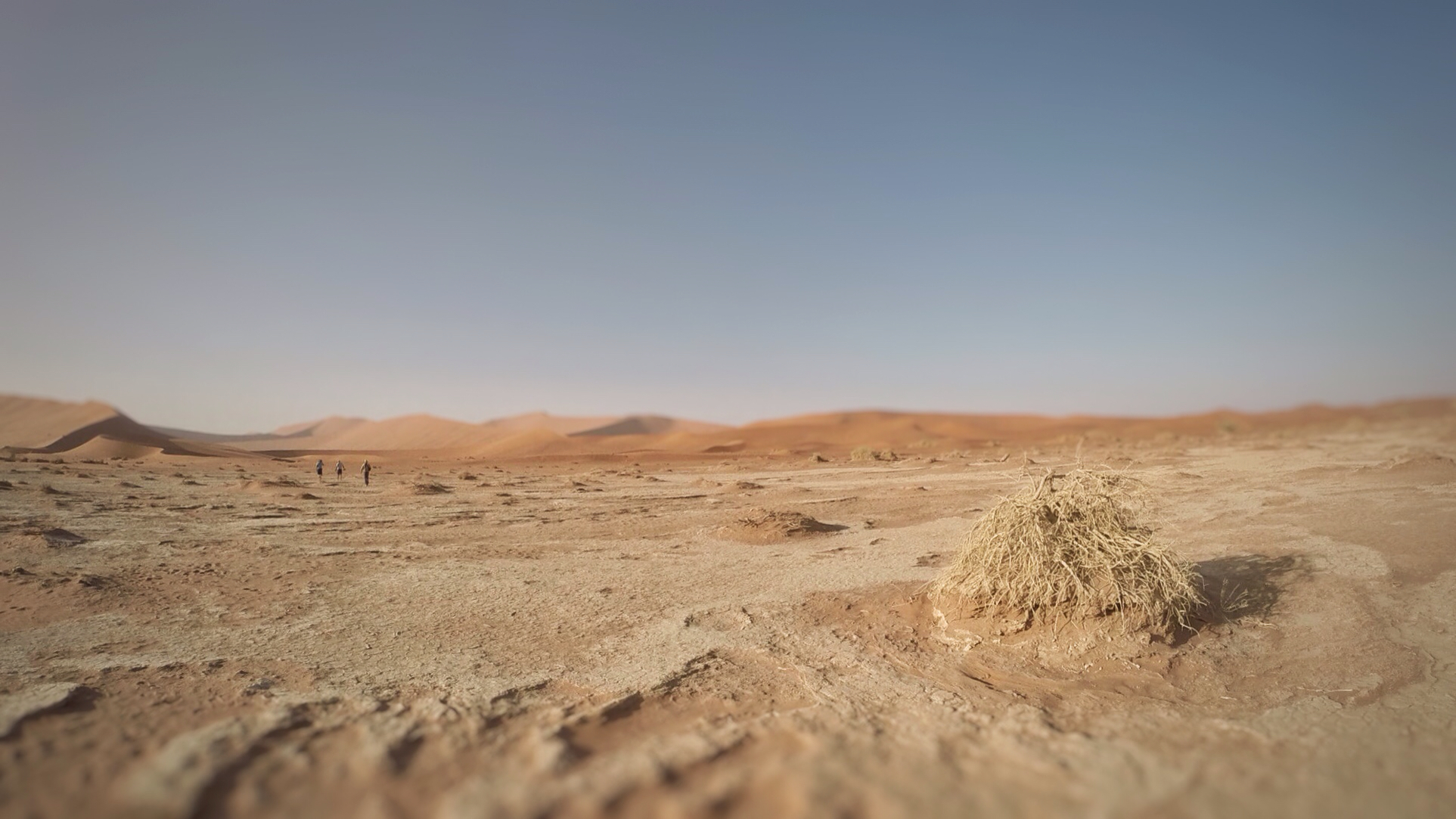
A few more miles down the road was the actual area of Sossusvlei. Several other cars and buses were all ready in the parking area. It was hard for Dave to stop taking photos. The area was so different from the location of our camp and scenic drive the previous evening. Orange and red sand was everywhere in really big piles.
Played around to give this one the look of another planet
We were given the options of climbing The dune named Big Daddy (900ft high), a sub-dune (450ft high), or stay level and go look at the trees. Judith had a bad knee and climbing was not an option for her. We chose the sub-dune in the interest of time and our cardiac well-being. The smaller dune was still no joke. Climbers have to walk up a narrow spine of the mound and each step digs deep down into the extremely soft sand. We needed many stops to catch our breath. Did we mention how hot the sun was already before 8am? It's a fond memory now but at the time it was not a pleasurable experience. Later on Eddie was kind by telling us we made it to the top very quickly.

This was about a half of the way up
Views from the top were great.
We thought there may have been a more preferred route off the dune than what we were witnessing. Turned out no. To go down we would have to just go down the steep slope.
We took very cautious steps down the mound. We didn't feel like falling and breaking something because we had a lot of trip left to go. Dave thought ahead and put his big camera in a baggie before trekking down the hill. The act of walking down the hill causes little avalanches and sometimes you hear the dunes roar as the sand shifts. It was soft sand, and very fine. At the bottom Dave emptied about two pounds of sand from each boot.
We were finally in Deadvlei. You've seen pictures of this area before: black trees against a red-orange sand background. A long time ago thee trees were suddenly cut-off from their water supply and quickly dried up. The lack of moisture prevented decomposition even though the intense sun has scorched them black. The trees are estimated to be 600-900 years old.
We made our way out of Deadvlei around 8:30am and it was WARM. Tour groups of folks older than us were just showing up and they were finding the small hills difficult to climb in this heat. The four of us re-entered our jeep (which Eddie smartly parked under a tree) and drove "across the street" to Sossusvlei itself. Eddie parked by another tree and told us to walk around for a few minutes while he set up a picnic. The area was fairly open and not full of many other tourists yet. A few folks were climbing Big Mama; another sizable dune.
We spent an hour enjoying champagne, cookies, sandwiches, and fruits under the shade of a thorny mess of trees. There were some field mice hanging out nearby waiting to enjoy whatever crumbs we would leave behind. We learned more about Judith's travel plans for the next two weeks and found out more about Eddie and the area of Namibia he was from. This conversation started Dave's "I have a map" ceremony. He picked up maps of Namibia in the Windhoek airport and kept them in his camera bag. Anytime a guide or someone else would bring up an area he'd announce "I have a map" and aid our geographical education.


The hour drive back to camp wasn't the most pleasant ride. It was warm, we were slightly drained from summitting the little sand dune, and the jeep had no A/C. Cracking the window open at these speeds meant dust showers so it took a bit to find the balance between breeze and sand. Back at camp we enjoyed lunch and the main camp pool (since our personal pool was being serviced that day). We'd leave at 4pm for our next excursion, to a canyon.

The dunes were amazing. Sand everywhere that changes colors every few moments as the sun shifts. We were really happy that our camp insisted on the early morning departure to keep the climb "tolerable". We could not imagine how much harder that climb could have been later in the day.


Tuesday, January 5, 2016

Charity of the Month: Force for Change/UNICEF Kid Power

Charity of the Month is a way Team Tizzel is helping to support some very worthy organizations. As part of this program, we will dedicate a post to a charity that we will sponsor through the month by donating Holly's training run money.

December: In December we sponsored Toys for Tots to help give children a little joy at Christmas time.  We had a fun buying several items before Christmas and dropping them off in a donation box at our local brewery (owned by an ex-Marine).  We will also be donating $125 to Toys for Tots via their website.

January's Charity:

Donate monthly to help children


Many of our readers know we are Star Wars fans.  We thought it would be fitting to find a way to tie-in the launch of The Force Awakens to the Charity of the Month.   Force for Change is an initiative managed by Disney and Lucasfilms  to partner with charitable organizations that inspire people to be "forces of change" in their lives.

One of the current initiatives supports UNICEF's Kid Power Project.  It is inspiring kids globally to live a healthy active life through a "good-for-life" wearable activity tracker.  Since Team Tizzel has a slight running focus we thought this was a perfect way to support Force for Change.

From the Kid Power website:

Be a Force for Change

Star Wars: Force for Change, a charitable initiative from Disney and Lucasfilm, is dedicated to finding creative solutions to some of the world’s biggest challenges and empowers youth to be global forces for change in their own lives and for children around the world. This year, Star Wars: Force for Change will benefit UNICEF Kid Power.

When you donate to the U.S. Fund for UNICEF in support of Star Wars: Force for Change, you will support UNICEF Kid Power and help children around the world grow up healthy. Kid Power is an innovative program that empowers kids to get physically active using the world’s first Wearable-For-Good. Built for a new generation of global citizens, Kid Power inspires kids to take action and help save the lives of children in developing countries with every step they take.
How it works:
  • Kids wear Kid Power Bands – the world’s first Wearable-for-Good – to measure their physical activity while they get active.
  • Activity and movement unlock Kid Power Points and the more kids move, the more points they earn.
  • Kid Power Points are converted to funding by partners, and funds are used by UNICEF to deliver lifesaving packets of therapeutic food to severely malnourished children.


By making a 100% tax-deductible donation to the U.S. Fund for UNICEF today, you can be a Force for Change and help children in the U.S. and around the world grow up healthy.

Star Wars Force for Change FAQ:

What is Force for Change?
Star Wars: Force for Change is a charitable initiative from Disney and Lucasfilm. Our goal is to harness the strength of Star Wars and its global fandom to empower people to come together to make a positive impact on the world around them. We want to inspire people to be “forces for change” in their everyday lives.

What does it have to do with Star Wars?
Following the massive global success of Episode IV in the late 1970s, fans began to embrace Lucas’ stories of struggle, hope and inspiration on a more personal level. Philanthropy was very important to George Lucas — he used early screenings to raise money for charities around the world with a particular emphasis on children’s healthcare and education. Over the course of the last 35+ years, Star Wars fans have continued George’s mission to support children in need, volunteering their time with costumed character visits at countless children’s hospitals and raising millions of dollars in donations. In the spirit of these fan-generated charitable efforts, Force For Change was born.

Who does it benefit?
In its current phase, Star Wars: Force For Change is collaborating with UNICEF to benefit Kid Power, an innovative new program that uses the world’s first wearable-for-good activity tracker to get youth physically active. The trackers provide lifesaving, nutrition-rich food packets to kids in need around the world, inspiring a new generation of global citizens who have an inherent desire to help others.

To support Kid Power, click on BB-8 below to go to their website.


Friday, January 1, 2016

Namibia: Little Kulala Lodge

Trip Overview Post

The main attractions in the southwestern part of Namibia are piles of sand. We were spending two nights at Little Kulala Lodge so we could be near some of the world's tallest (and oldest) sand dunes. We were in the Namib Desert, an area defined in Wikipedia as: "a coastal desert in southern Africa. The name Namib is of Nama origin and means "vast place". The Namib stretches for more than 2,000 kilometres (1,200 mi) along the Atlantic coasts of Angola, Namibia, and South Africa." The Namib is 120-280 miles wide.

We flew in on a tiny plane and our landing strip was mostly gravel and the surrounding area was dotted by random trees and some small bumps of mountains around the way. Our first impression was "look at all this nothing". But later on, the nothing actually became something. It was big and it was quiet. On the drive to camp we did get to see some springbok, oryx, and ostrich: the only game in the area.


Little Kulala from the air
We received a warm welcome at the lodge and were given an orientation. We knew this would be one of the nicer lodges of the trip, but we weren't prepared for all the features this camp provided. Our stand-alone unit was not the traditional canvas tent walls like other camps we've stay at. Kulala's 10 units were brick-and-mortar which meant we had air conditioning. This area definitely needed it since it was hot like an African desert. Another surprise was the wi-fi access in our unit. Definitely not expected. We used it sparingly to post a few pictures and let folks know we made it to our destination. Other nice amenities included a plunge pool, rooftop deck with sky bed for star gazing, and an outdoor shower. We were spoiled with a stocked refrigerator of water, sodas, beer, and liquors (camps are typically on an all-inclusive plan so no further charges for these items, or any other food/drink from the main bar except for premium wines).

Staff makes up the bed at night for star-gazing
Main dining area, lounge, and bar.
Camp library with games, books, and lots of seating.
The outer deck of the camp's main area had a great view of sand, trees, and mountains.  There was a watering hole near the outdoor deck that brought a parade of thirsty animals. 


We enjoyed watching the way ostriches drank water.
Someone actually wanted to take a nature walk to that mountain. It was really hot when they started and we thought they were nuts.
Eddie was our assigned guide. Each guide handles guests from 1-3 units depending on schedule of arrival and departures. We were the only guests doing an activity with Eddie our first night because the other guest was tired from a long day of travel. We had our choice of riding ATVs or taking a scenic drive. We chose the scenic drive because we expected to ride ATVs later in the trip. Eddie took us to a small mountain with a little cave a bit of a ways up the slope. Along the way we stopped to take a look at some plants and trees and saw an incredible sociable weavers nest. Sociable weavers are little birds that build their nests together into one big bird condo. Eventually these get so large that they take down trees.


Eddie said this was a 2 million year old painting.  Looked too good to us to be from a caveman.
On our way back to camp we stopped for our favorite African tradition: Sundowners! Eddie chose a great location for us to stop the truck and enjoy watching the sunset behind a mountain with some cocktails.


We finished our day with a great meal back at camp (meals in camps cater to European tastes and main entrees are typically fish, beef, chicken, lamb, and local game meat) and some time at the bar talking to the staff. It's great to hear about how they live and what brings them to work in such places of isolation. Most of them work three months straight, then have a full month off.

Our great first day had to eventually come to an end since we had a 5:30 wake-up call the next morning for our visit to the dunes.